India's Private Credit Opportunity: My Conversation with Private Debt Investor
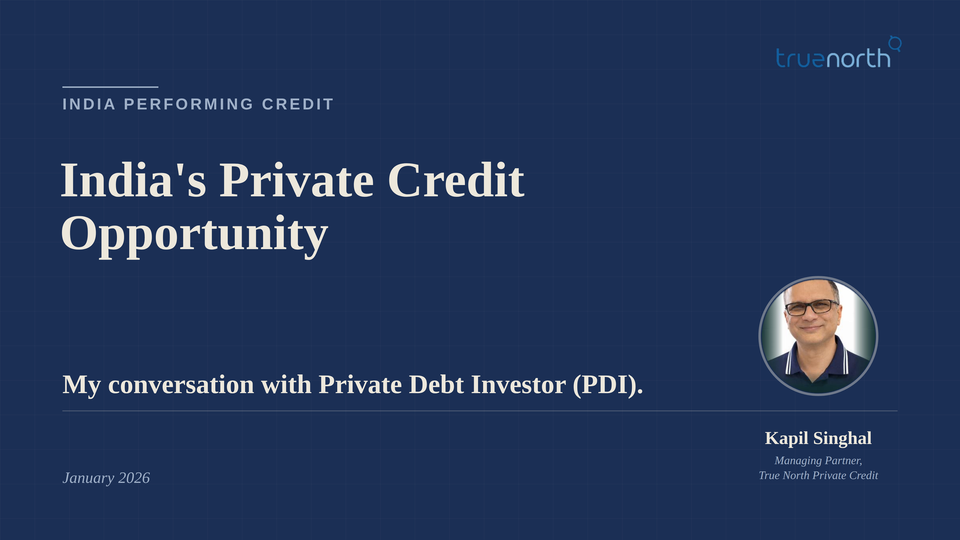
Private Debt Investor (PDI) — the PEI Group title that is the publication of record for the global private credit markets — carried an Expert Q&A with me in their December 2025 / January 2026 edition. The full interview is available here on PDI (subscribers can access the print and digital edition titled "India's private credit opportunity").
Below is a short excerpt from the opening of that conversation, followed by my own summary of the key themes we discussed — written for readers of this blog who may not have access to the PDI edition. For the full interview as edited and published by PDI, please refer to the link above.
A short excerpt from the published interview
PDI: How has India's private credit industry evolved over the years?
There was no significant non-bank lending market in India until around 2015. Following the provisioning practices undertaken by Indian banks, the private credit market's next phase of development was dominated by non-bank finance companies (NBFCs). The years between 2015 and 2018 were largely defined by an increase in structured collateral-based lending — with faster execution than banks and minimal presence of private credit AIFs.
Then, in 2018, the default of IL&FS triggered a liquidity crunch across the NBFC sector. Corporate lending by NBFCs almost came to a halt from 2018 onwards.
Between 2018 and 2022, private credit AIFs — predominantly focused on refinancing of NBFCs' debt with limited focus on underwriting business growth — became popular. Governance and founder integrity were the key filters for success; industry insight was secondary.
More recently, we have started to see performing credit managers being launched. Post-Covid, attention has turned to growth financing in performing credit, or what in the US would be called direct lending. We believe this to be a multi-decade opportunity driven by strong GDP growth and robust growth aspirations of founder-driven companies which, unlike in the US, are not driven by private equity.
[The full Q&A continues on PDI — including questions on today's opportunity, competitive dynamics, pricing, and advice for global GPs and LPs.]
My summary of the other themes we covered
For readers who don't have access to the PDI edition, here is a quick run-through of what else we discussed. These are my views, written here in my own words.
On what the opportunity looks like today
India's GDP is around $4 trillion. The banking book is around $2 trillion. Private credit across corporate lending, distressed, venture-backed and real estate sits at around $25 billion — roughly 1.2% of the total corporate lending market.
That is a small base on a large economy. We believe this market can grow at 50% year-on-year for the next five to seven years.
The opportunity in performing credit is driven by stakeholder consolidation, pre-IPO financing, growth financing, and bespoke, flexible and quick financing across multiple end-uses.
Speed, flexibility and certainty now define the market.
One important nuance: unlike in the US and Europe, direct lending in India does not form a permanent part of the capital structure. These financings typically remain in place for 18 months to two years before banks or public markets refinance.
That means maintaining deployment and AUM over time requires a strong, on-the-ground presence and continuous origination. You cannot rely on positions running for years.
On leverage: the average Indian borrower is smaller in turnover and EBITDA than US borrowers, but total leverage (bank plus private credit) in India typically stops at around 4x, versus 6x which had become common in the US. This adds to overall credit safety.
On competitive dynamics
A large part of India's mid-market remains undiscovered.
Very few investment banks can present fully-structured deals. Many of the companies we meet on a weekly basis are not even aware that a product like ours exists.
In the US, mid-market dealflow is largely intermediated. In India it is not.
There are fewer than 20 private credit players operating in India and the opportunity is very large. For those who source proprietary transactions, the market does not feel competitive.
On pricing
Pricing will feel competitive to firms that only compete for the handful of widely-marketed deals.
For bespoke transactions sourced directly, pricing is stable and attractive.
At True North Private Credit, we have completed 11 exits out of 23 deals, generating an IRR of more than 20% on our exited portfolio. Since this is performing credit — rather than distressed or venture — those returns illustrate the scale of the opportunity in this market.
Negative pricing trends shouldn't concern firms with local origination channels and relationships.
On advice for global GPs setting up in India
Three things.
- India is not a fly-in, fly-out market. A global GP needs a sizeable Mumbai-based team to succeed, along with established banker and founder networks
- A strategy entirely based on the Insolvency and Bankruptcy Code is unlikely to succeed. The code is well written but execution is imperfect. Collateral cannot be the starting point — good underwriting, founder relationships, short tenors and careful structuring come first. Business should be prioritised ahead of collateral
- Diversification is critical. The best returns are often found among smaller borrowers, and given the legal system, concentration risk is more acute. Some funds invest in 10–12 deals per fund, which we believe is insufficient. Prepayments are frequent and require continuous origination capacity
On the message to international LPs
Raising capital from international LPs for India has historically been challenging. The legal system involves slow recoveries and matters can progress inconsistently.
But the regulatory environment has improved meaningfully over the past decade.
The core question is whether India is worth allocating to. India is now one of the top four economies globally. China is slowing. India continues to grow.
Now is the time for LPs to establish long-term relationships with India-focused managers they can trust.
LPs that try to time a single vintage may miss the multi-cycle opportunity that Indian private credit offers.
The full Expert Q&A appeared in the December 2025 / January 2026 edition of Private Debt Investor. The print article is the work of PDI's editorial team and is reproduced here only in short excerpt; the rest of this post is my own summary written for this blog. For the complete published version, please refer to Private Debt Investor.
Kapil Singhal is Managing Partner at True North Private Credit.
Member discussion