What Is - and Isn't - Wrong With Global Private Credit
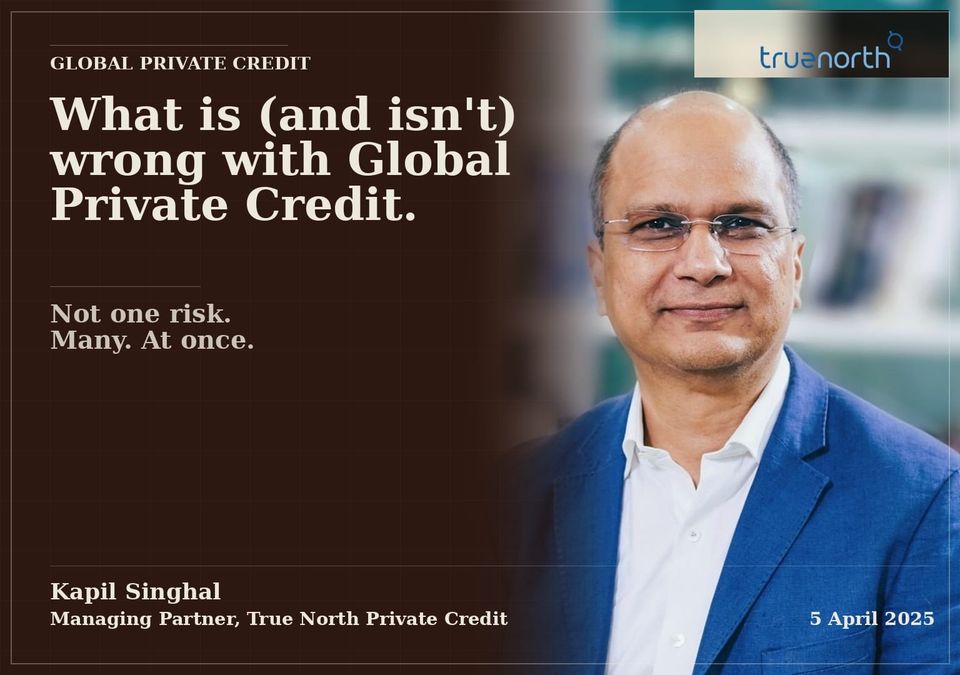
Not One Risk. Many. At Once.
Credit Quality. Leverage Stress. Liquidity Mismatch. Opacity and Dilligence.
Macro as a final Accelerant.
This piece was first published on LinkedIn in April 2026. Read the original post here.
Global private credit is not breaking. But something is clearly changing.
A lot is being said right now - some of it directional, some of it noise. The reality, as always, sits somewhere in between.
In the last few months alone - First Brands with liabilities estimated far above disclosed debt, Tricolor with alleged collateral misrepresentation, Saks, MCC and STG Logistics going through restructuring or bankruptcy. PE-backed companies defaulting at roughly 2x the rate of non-PE companies.
None of these, in isolation, defines the market. But together, they point to something deeper.
It's not one issue. It's multiple fault lines starting to move together.
I had written earlier on why global private credit issues do not translate directly into India. Since then, several people asked me to step back and look at this separately - what is actually going on in global private credit, independent of the India lens.
This is that attempt.
1. Defaults - not just rising, changing
Defaults are rising. That part is known.
What is different is the nature of these failures.
Recent cases - First Brands, Tricolor, Market Financial Solutions, Saks Global, Multi-Color Corporation, STG Logistics - show similar patterns:
- Leverage higher than disclosed
- Collateral weaker than assumed
- Structural opacity - including double pledging in some cases
- Issues surfacing too late
A few examples:
First Brands - ~$5.8bn in term loans, but liabilities estimated far higher due to off-balance sheet structures. Allegations of double-pledged collateral and ~$2.3bn "missing."
Tricolor - subprime auto lender with ~$945mn ABS exposure. Alleged misrepresentation of collateral.
MFS (UK) - ~£2bn borrowings with ~£930mn collateral shortfall across lenders.
This is not just credit risk. This is opacity and diligence risk.
The question is no longer only "is the credit good?" - it is also how much you can rely on the information you are underwriting.
2. Software exposure - probably understated
This is a quieter fault line.
Once reclassified, software exposure in large private credit funds appears materially higher than disclosed:
- Blue Owl: 11.6% → ~21%
- BCRED: 25.7% → ~33%
- Ares: 23.8% → ~30%
- Apollo: 13.6% → ~16%
Why this matters - these loans were done at peak multiples, with optimistic EBITDA assumptions and covenant-lite structures. That worked in a zero-rate world.
At 10-12% cost of debt, the same structures behave very differently.
Banks seem to be adjusting faster. JPMorgan has already marked down some exposures. Many funds are still holding at par.
Pricing may not yet fully reflect the underlying risk in this segment.
3. The leverage math has changed
This is the simplest part.
6-8x leverage. +500 bps rate move. Floating rate debt.
Result - interest coverage slipping below 1.0x, PIK elections rising, stress getting pushed forward.
Bad PIK is not a solution. It is a signal.
It tells you cash flows are not sufficient today, and the system is choosing to defer the problem rather than resolve it.
4. Liquidity - theory vs reality
The model - illiquid 3-7 year assets, periodic liquidity of around 5%. Works when inflows are steady. Gets tested when they are not.
Recent data points:
- BCRED: ~7.9% redemption demand vs 5% cap
- Cliffwater: ~14% demand, ~50% unmet
- Morgan Stanley: ~10.9% demand
- BlackRock, Apollo, Ares - similar pressure
When demand exceeds structural design, managers face a choice - gate or sell. Selling in a thin market converts marks into realised losses.
Liquidity here is not just a feature. It becomes a source of risk when the cycle turns.
5. Macro is now inside credit
Earlier, macro sat in the background. Now it sits inside the model.
Inflation, energy costs, geopolitics, AI-led disruption - the transmission is direct.
Higher costs → lower EBITDA → weaker coverage → defaults.
It builds gradually. Then shows up in credit.
6. When exits slow, structures evolve
Two things are now happening together - macro pressure and slower exits. That combination did not exist like this before.
The Carlyle CFO structure - LP stakes pooled, tranched, sold - is smart structuring. But it is also a signal. Liquidity is being created, not exited. Which typically means normal exit pathways are not working smoothly.
What still works well
It is easy to focus only on what is going wrong. A few things are still fundamentally intact.
This is still a developed market product. Legal systems work. Enforcement works. Before private credit takes meaningful losses, equity has to get wiped out. That basic capital structure discipline has not changed.
Software exposure is higher than disclosed, but it is still a part of the portfolio, not the whole portfolio. For most funds, probably in the 20-25% range. And even within that, not everything goes to zero.
Portfolios are reasonably diversified. Most large private credit funds run 80-200 companies, with average position sizes of 1-3%. Isolated credit events, even if sharp, do not necessarily translate into portfolio-level impairment.
And while this is not a liquid market, it is more liquid than emerging markets like India. Positions can move - into distress funds, continuation vehicles, structured solutions. That moderates outcomes.
This does not eliminate losses. But it still looks like a credit cycle - not a structural failure.
So what is really happening?
This is not one issue. This is convergence.
Credit quality weakening. Leverage stress. Liquidity mismatch. Opacity and diligence gaps. All moving together. Macro as the accelerant.
Each of these is manageable individually. When they show up together, the system behaves very differently.
What this is - and what it isn't
This is not private credit blowing up.
But it is a real test. A test of underwriting discipline, structuring, and portfolio construction.
And this is no longer a deal-by-deal game. This is portfolio outcome.
Bottom line
Private credit did not misjudge one variable.
It misjudged the possibility that multiple things move together - leverage, liquidity, visibility, and macro - all at once.
Not collapse. But clearly - a test.
One final point
The convergence we are seeing globally does not exist in India - structurally.
- Borrower leverage below 4x
- No fund-level leverage
- No redemption pressure
- Limited software exposure
- Relatively stable banking system
Same label. Very different risk.
Applying global narratives directly to India can be misleading.
"It ain't what you don't know that gets you into trouble. It's what you know for sure that just ain't so."
Member discussion